CNC – Mohs scale of hardness and cutting tool materials
When a cutting tool cuts a workpiece, it is basically a scratching of one material by another. The tool, which is the harder material, scratches the workpiece, which is the softer one.
Scratch hardness is defined on the Mohs’ scale of hardness (developed by Frederich Mohs, a German geologist, in 1822), on which Talc is 1 and Diamond is 10. It was originally developed as a measure of the relative hardness of minerals.
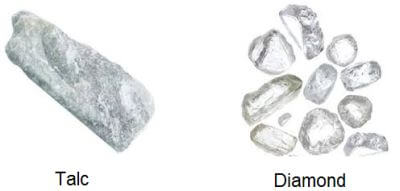
Hardness technically is the ‘Resistance to permanent deformation’. The Mohs scale is relative, while Vickers, Rockwell, Brinell and Knoop are absolute measures of hardness. Mohs is a measure of scratch hardness, while the rest measure indentation. There is however a direct correlation between the two, because scratching involves two actions: 1. Pressing the the harder material into the softer one – the indentation. 2. Moving the harder material at the indentation depth – the scratching.
Scratch hardness of some cutting tool materials and other common materials: