CNC: Rigid tapping – the better way to tap on CNC machining centers
Rigid tapping, also called synchronous feed tapping, eliminates the need for a floating tap holder (see this previous post). In a rigid tapping cycle the machine spindle rotation and feed rate are synchronized to match a specific thread pitch. The problem of lack of synchronization at the bottom of tapped holes is eliminated, and a solid holder without any tension-compression can be used, instead of a floating tap holder.
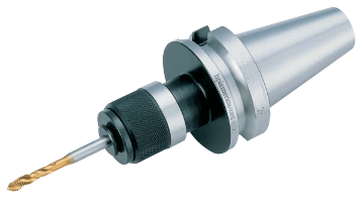
Rigid tapping is possible only on machines that have the feature. With this features, the controller constantly gets feedback on the spindle speed, many times within a revolution. It micro-adjusts the feed rate to match the tap pitch. Without this feature, the spindle can only be commanded to start at a particular speed or commanded to stop and there no continuous feedback on the spindle speed.
Rigid tapping results in shorter machining time, better part quality, and better tap life. It is also better for tapping of blind holes where the tap depth needs to be controlled. With a floating tap holder you cannot predict the final depth, and depth control is possible only after trial and error, ruining a few parts or breaking a few taps.
Sometimes you may have a problem in rigid tapping because of machine or tap inaccuracies. These inaccuracies make it impossible for the machine to exactly match the pitch of the tap being used. If a solid holder is used, this discrepancy is bad for the thread quality and tap life because extra axial forces are exacted on the tap. To fix this problem, you get rigid tap holders with a small float (maybe 1 mm., against 10 mm for floating tap holders).
Pics. and text source: CADEM NCyclopedia multimedia CNC training software.