CNC: End mill helix angles – how do they matter?
Like inserts and turning holders, boring holder names too follow an ISO nomenclature standard. Also, like for inserts and turning holders, if you have anything at all to do with tool selection on CNC lathes, you need to understand this nomenclature.
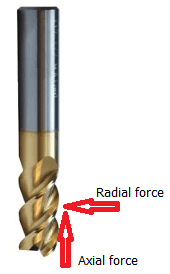
The cutting force on an end mill has a radial and an axial component. The radial component tends to bend the end mill and results in vibrations, while the axial component presses the end mill against the holder.
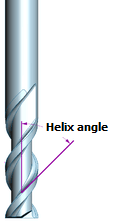
The higher the helix angle, the greater the proportion of axial force. On a 0 degree end mill (straight end mill), all the force is radial. Also, as each edge comes in contact with the work piece material there is a sudden shock load. This causes vibrations, poor surface finish on the part, and poor tool life.
On an end mill with a 30 degree helix angle, 25 % of the force is axial and 75 % radial. On a 45 deg. helix angle, the forces are divided equally, 50 % radial and 50 % axial. High helix cutters have an helix angle of 60 deg.
At a higher helix angle the radial forces are lower and cutting is smoother, vibrations lower. Surface finish and chip evacuation are better. The cutter is however weaker, cannot take heavy depths of cut and feed rates. It deflects more. Lower helix angle cutters are stronger, but the cutting is less smooth.
For heavy cutting where the finish and tolerance are not important, use a lower helix angle cutter. For lighter cutting where the finish and tolerance ARE important, use a higher helix angle cutter.
This post was prompted by a query in my last post from Mr. Shane Rozario. Thank you Mr. Rozario.
Text and pics. source: CADEM NCyclopedia multimedia CNC training software.