CNC: Anvils in threading tools – small things that make a big difference
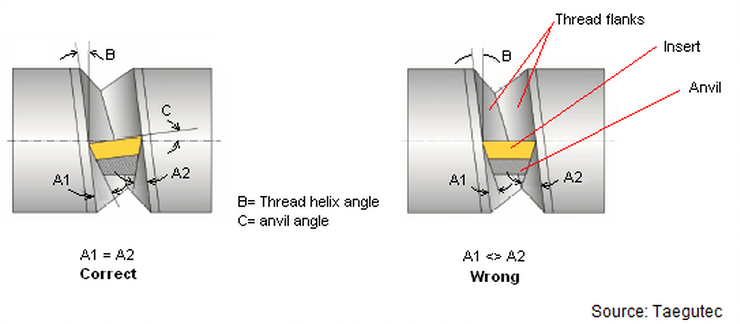
The insert is therefore seated at a sideways angle on an Anvil, or Shim – some manufacurers call it an anvil, and some call it a shim. The anvil orients the cutting edge so that it is perpendicular to the flank, and the clearance angle on both sides is equal. An appropriate anvil must be used based on the helix angle of the thread.
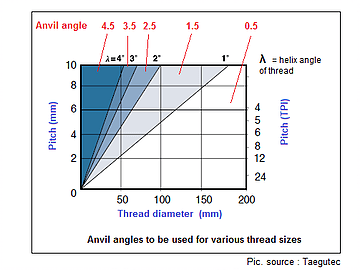
The picture shows the helix angle for various combinations of thread diameter and pitch. E.g., if the thread diameter is 50 mm and pitch is 4 mm, the helix angle is somewhere between 1 and 2 degrees, closer to 2. Cutting tool manufacturers have standard anvils from 0.5 and 4.5 degrees, in steps of 1 degree. Each coloured band in the picture represents an anvil angle. E.g., if your thread size falls in the white band, use an anvil of 0.5 degree.
Action point
When you buy a threading holder, it comes with an anvil of 1.5 degrees. Use the graph in the picture above to quickly determine the anvil angle, and use the appropriate anvil.